Saturday, February 5, 2011

Can you identify these relatives?

Below are some verified photos of Elias and Sarah (Brown) Locke.  This first photo may be the same couple.
Could this be Elias and Sarah (Brown) Locke?
They were married in 1845 and would have been 24 then. This original is printed on heavy paper which is consistent with calotypes, invented in 1841.  Calotypes were not as clear as daguerreotypes (1837), but multiple copies could be printed on paper.  The back is marked "E. H. Keney, Photographer, 406 E. Fifth Street, Dayton, Ohio." 
Follow-up internet research: 
Erastus H. Keney was born in New York about 1838 and was active in Dayton from 1870 to 1900.
Answer: No, this is not Elias and Sarah, but could be a photo of one of their children.

Sarah (Brown) Locke (b. 12/29/1824; d. 8/25/1907)
Elias Locke
Sarah (Brown) Locke
Elias Locke
Sarah (Brown) Locke
These photos are identified as Abraham and Rebecca (Ott) Lock, parents of Elias (above).  Could someone verify this?
Abraham Locke (b. 6/20/1794; d. 9/15/1872)
Rebecca Ott Locke  (b. 9/28/1794; d. 11/6/1869)
 Parents of Abraham Lock?  Don't think so.
This photo is identified as the parents of Abraham Lock ( John Lock b. 7/4/1755; d. 10/4/1818); Salome b. 1755; d. 12/24/1840), which is impossible since the daguerreotype wasn't invented until 1837, calotypes in 1841, and tintypes were not common until about 1860.  This looks more like a Touby face to me. 
Is it possible that this is Peter Touby and his mother, Anna Marie Slout Touby?
John Peter Touby
( b. 1/20/1824; d. 10/27/1888)
John Peter Touby
( b. 1/20/1824; d. 10/27/1888)
The children of Elias and Sarah Lock.  Does anyone have the originals?


cousin
cousin
Is this George Luther Locke?
Dr. John Edgar Locke
William Locke
Laura Locke Tresslar
Are these Locke brothers?  Compare to the brothers above.  
A couple of them could be husbands of Locke women.
I think this is Antrim "Bud" Locke
These images were in the same album and could be Locke sisters or wives of Locke men.

Information on the back of this photo:
J. Nicholson, photographer.  Over Darnall and Scotton's Drug Store, Main Street, Kokomo, Ind.
Pictures copied enlarged and colored in every style.
Research: Nicholson was born in Franklin, Indiana (2/12/1866) and was engaged in painting in connection with cultivating fruit and later learned the art of daguerreotyping.  In 1872 he moved to Kokomo, Indiana and from there, in 1879, to Crawfordsville, where he opened an art gallery.

This tells us that the photograph was taken (or copied from the original, as the ad states) between 1872 and 1879.


Are these Locke children?

Friday, February 4, 2011

Elsie and Ross: on to University

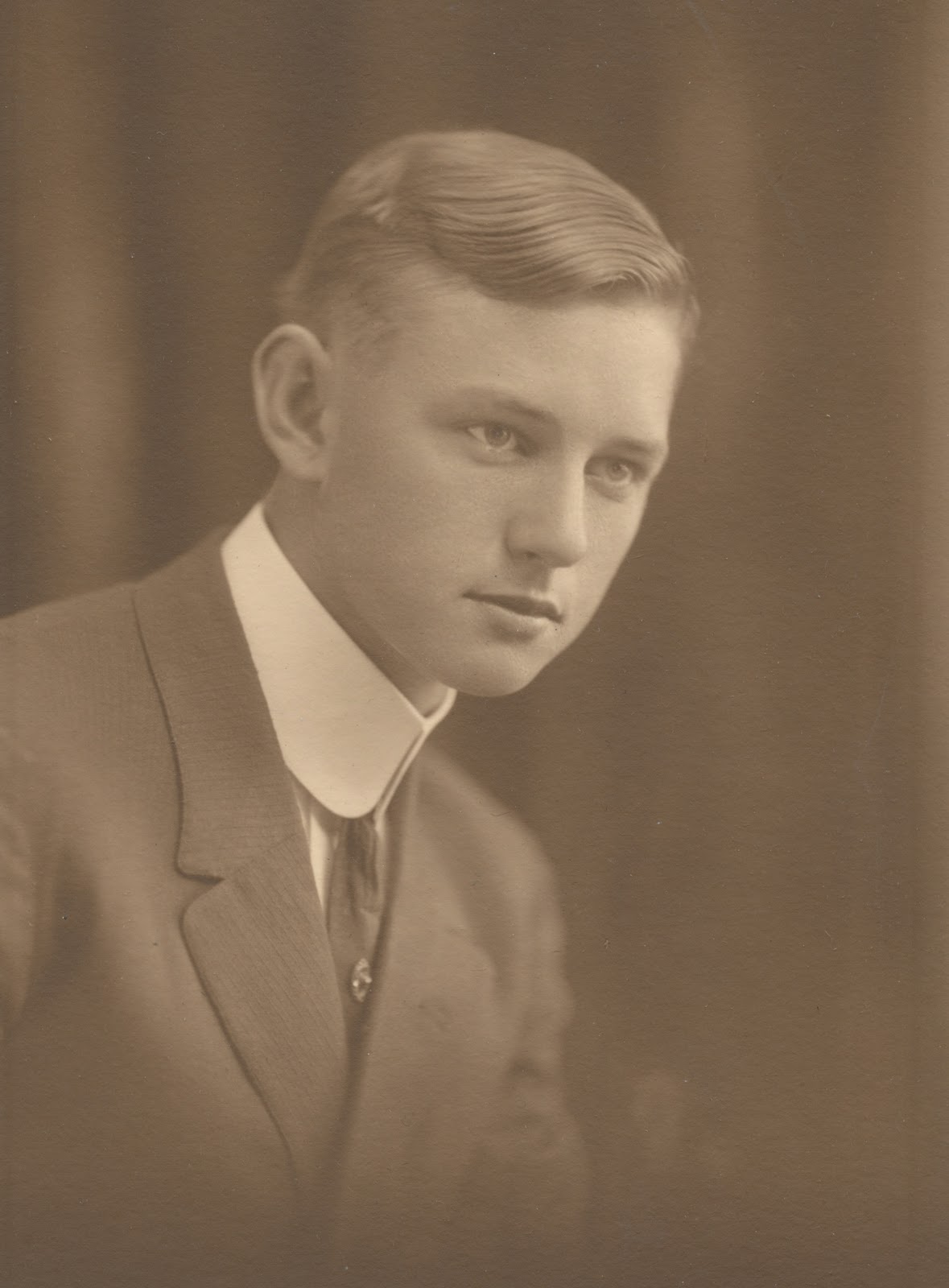
Philip Roscoe Locke and Elsie Locke
Elsie and Ross went downstate Indiana for their university studies: Elsie to Indiana State Normal School and Ross to Indiana University.
Indiana State Normal School
Elsie, on left
Friends at Indiana State
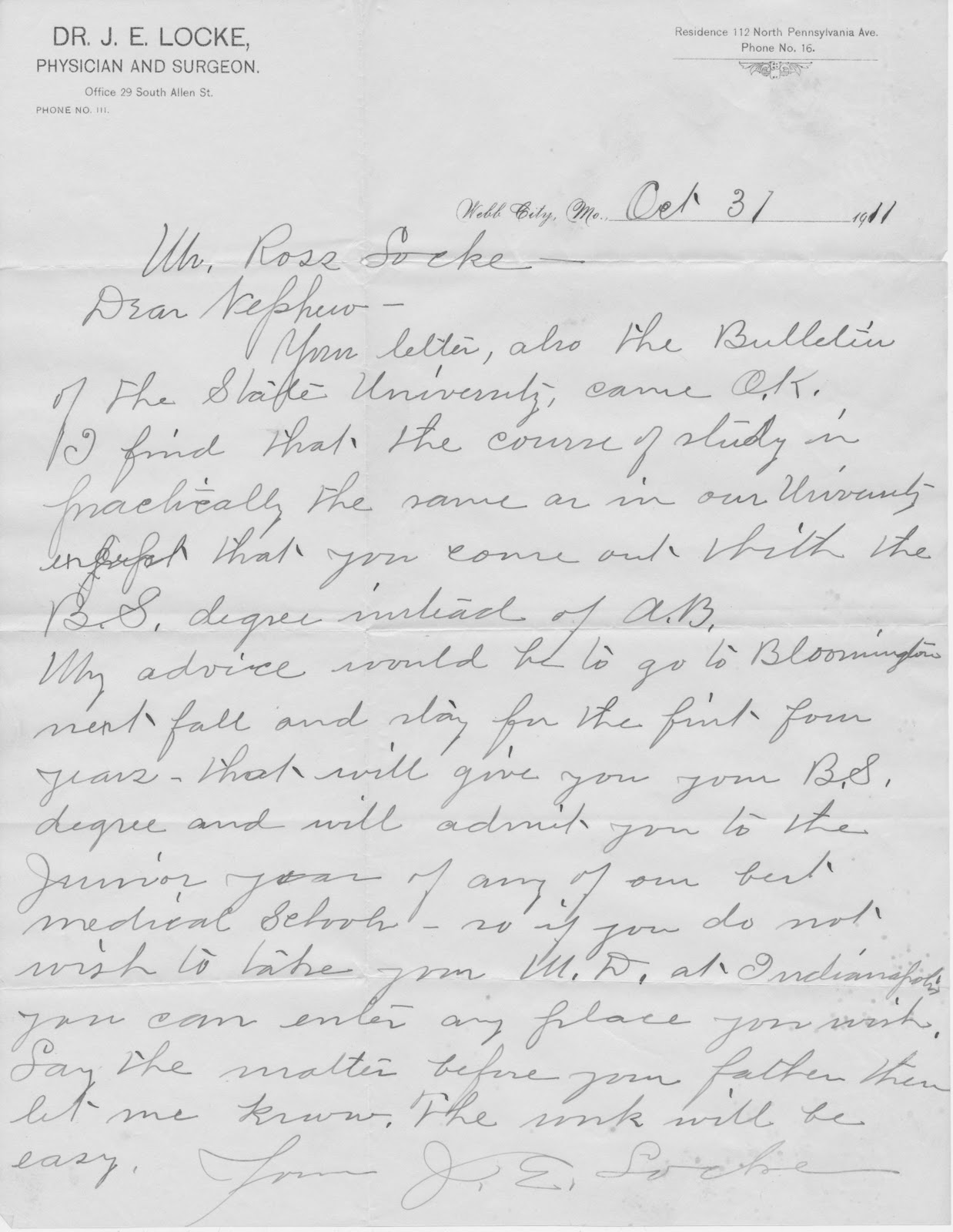
Ross was encouraged by his uncle Dr. Edgar Locke to pursue medicine.  Ross actually started with that in mind, but his love for writing lead to studies and a career in journalism instead.
Philip Roscoe Locke
Letter to Ross from his uncle, Dr. J. Edgar Locke, written 1911 (100 years ago!)
when Ross was a high school senior
Dr. John Edgar Locke

Sis Hopkins

This ticket was found in Roscoe Locke's small Shakespeare tome Merchant of Venice.  He might have taken some time from his studies to see a local vaudeville act.
Melville, Rose (1873–1946), actress. Born in Terre Haute, Indiana, she made her debut in 1889 then scored a major success in a touring play called Zeb, in which she appeared as the hayseed Sis Hopkins. Melville played the part so well that it was elaborated for her, then she developed a vaudeville sketch around the same yokel. In her Broadway appearances, in such musicals as Little Christopher Columbus (1894) and By the Sad Sea Waves (1899), Melville invariably portrayed Sis. She played little else until she retired sometime in the 1920s.

Thursday, February 3, 2011

The Huckster Wagon

Mr. Beebout's huckster wagon was a variety store on wheels.  The wagon wound its way along bumpy country roads, the contents invariably shifting and in need of frequent reorganizing.  Its drawers were filled with thread and needles, candies, paper goods, pantry supplies, and more.  It was always a treat when Mr. Beabout came by.  He had a regular route...after stopping at Mrs. Householder's, he would drive on down to the Touby farm.  One day as the girls watched for him, he stayed longer than usual at Mrs. Householder's place.  Joan, the youngest, innocently remarked that, "Mr. Beebout must have dropped his drawers!"

As far as I know, we don't have any photos of Mr. Beebout and his huckster wagon.  I'd love to find one.  But I imagine that it might have looked something like this...


It was not uncommon for the huckster man to trade a chicken or eggs for goods from the wagon, but I don't know if Elsie ever did trades.  I'll have to ask Aunt Dorothy or my mother about that some day.

Wednesday, February 2, 2011

Aunt Francie's Diary


Our Aunt Frances was the middle sister, born in 1919.  During my grandmother's pregnancy she contracted influenza...fatal to many during the "Spanish flu" pandemic at the end of WWI.  Frances had difficulties from birth.  My mother remembers knowing that Frances was different, but she was their sister.  All the girls had chores and Frances was in charge of clearing the table and washing dishes.  I remember helping Aunt Francie even when I was little.  She was in charge and I was her helper.  I never thought of her as being small, because I was small then.  But now, looking at pictures, I realize that she was.  Mother tells me that she didn't grow physically beyond the size of a pre-teen.  My grandparents hired a tutor to help Frances, but she never learned to read or write.

One of the most poignant moments of my recent stay with my mother was what we found when my cousin Mark came over with four boxes filled with family memories.  There were precious photos, yes, but when we opened a little red booklet we found a diary...not written by Frances, but obviously dictated by her.  Her entries were filled with swinging, sitting and playing on the porch, and many mentions of who visited on any given day.  What a wonderful thing my grandmother did for Francie to give her a voice, to validate her days and give them importance.  As her sisters were going off to school, Francie had her own teacher come to her house.  As her sisters did their homework, Francie dictated entries for her diary.

Monday, January 24, 2011

Graf History

Settie Graf Locke (1868-1955) wrote this account in 1954. 


The effects of the Napoleonic wars were still felt keenly in Germany, which at that time was but a loose confederation of States ruled or presided over by Kings, Bishops Landgraves or others potentates, unorganized as a sovereign nation.  Not until Bismark in 1871, in the war with France, subdued their enemies did Wilhelm I become emperor.  Before that, foreign soldiers were quartered in every home until children learned another language.  Soon after this, Philip of Roggenhausen (July 7, 1824) was born in Bavaria, the eldest son.  The boy, of husky stature, grew to maturity and helped his parents till the small farm, and in winter he became a weaver of linens.  His brothers were allowed to learn more remunerative trades such as cabinetmakers.  Philip looked after their parents and provided the means for the brothers to emigrate to America, to avoid the draft.  Service in the army took seven years of the best years of every man selected.*  Before their majority they sent the boys to relatives in Indiana, which was then being hewed out of the wilderness.
China tea jar and pitcher
All of Valentine and Barbara Graf's belongings were packed in a trunk to make the voyage from Germany to America.  It is quite remarkable that these china pieces survived.  This pewter charger is stamped with the insignia of the maker.
Pewter charger with maker's insignia
When this had been done, Philip and his parents sold their beloved home and personal effects and prepared to follow the boys.  Their nearest route was through France and from the dock at Havre they took ship.  Their household effects, clothing, cooking utensils, pewter table service and food, all stored in cedar chests for the long passage.  Steamboats had not been invented nor airplanes, so they set sail and selecting the route favored by the trade winds.  Unfortunately a storm drove them out of their course and they were six weeks on the ocean, arriving at New York harbor 1853 to be welcomed by friends who had braved the voyage earlier.  Then by wagon and canal boat, drawn by mules on the tow path, the party came overland to Waupecong where they found refuge among relatives and joined John, Christian and Valentine who had all found employment.  
Now to establish a home and care for the father who was ailing was the next concern.  Having paid for their passage, they were able to purchase a farm of forty acres, improved with a hewed log house and a log barn and a well.  A formal garden was soon laid out with flower beds planted to tulips and hyacinths which had been stored in the cedar chests.  
Next an orchard was planted, as there was no other fruit in Indiana but wild grapes, wild plums and berries.  Every foot of soil was planted and tended by hand.  Grass for hay was cut with a scythe or a sickle.  Grain was thrashed with a flail.
Clay mud mixed with straw was tramped by horses or cattle to chink the cracks between logs.  The broad ax and adz were used to dress the floor of puncheon, since saw mills had not yet arrived.  Neighbors were friendly and using the sign language soon showed the Germans how to make maple sugar, which lasted a year. 
Cattle were allowed to roam at will, only the crops being fenced in.  The leader wore the cow bell which helped in the hunt.  Philip refused to eat butter when the cows ate ramps, since he disliked onions.  Cottage cheese and ball cheese were always to be seen on the family table.
The spinning wheel spun tow and wool for the linsey-woolsey which was the cloth from which every day clothing was made.  The broadcloth and embroidered silk vers of the fatherland were out of place in the crude life of Howard County in those days, but were used for his burial.
Settie Graf Locke, demonstrating spinning
 This is the Graf Family spinning wheel referred to in Settie's account.  Here, Settie is participating in a Pioneer Days reenactment.
According to holy writ, it was not good for man to live alone.  Philip’s mother, Barbara Wagner Graf, no longer young, welcomed the young and beautiful Caroline Schaaf who came from Ohio, to dress the garden of Graf, instead of Eden, and became the helpmate of Philip and to mother his children.  Times were hard when the Civil War broke out and their first child, Emma, was born in 1861.  The draft caught up with Philip, but being a farmer without help, he was deferred.  Privation and illness were the lot of the young family, but gifted with a singing voice and a love for flowers and a cheerful disposition they bore the loss of their sons as best they could.
Came now the reconstruction days, illness and high taxes, muslin at 75 cents a yard, likewise calico.  Grandpa Graf sold hickory ax handles at 25 cents each, made brooms, bee hives, ladders, quilting frames and gates, grafted his own fruit trees, became a self-made veterinary and a Democrat.  In the home we enjoyed homemade cheese, smearkase, kraut, pickled beans, apple butter, cider, honey, liverwurst, maple syrup, pork, potatoes, bread and cakes made of yeast dough with a fruit topping.  Also flannel petticoats – home spun – and stockings knitted from home spun yarn, dyed analyne red, walnut brown, black or cochineal red.
Handmade sausage mill
Rag carpets soon gave the living room a festive appearance, muslin curtains and husk door mats showed the family to be progressive and the dance, the singing school, the taffy pulling, husking bees and the apple cutting for apple butter all afforded opportunity for the social life of the community.  Not to be overlooked was the spelling school and the barn raising and quilting bees for the ladies.
Happiness and contentment are a state of mind and do not depend upon worldly possessions.  Things which endure are those of the spirit.  To sit at the bedside of a sick neighbor, to officiate at a birth or death, to plant or harvest the grain of a bereaved widow, to sew for a motherless family, all help to cement a friendship, which nothing but adversity can make us appreciate.
We travel this road but once.  “Let us live in the house by the side of the road, and be a friend to man.”
                                                     Grandmother
                                                     May 17, 1954

* For a very well-researched account of military service, click here to read a post by
fellow blogger, Kathy Gosz. 

Philip and Caroline Graf, Settie's parents
Settie as a young girl
Settie Graf
Settie Graf Locke in 1950s, when she wrote this account

Martin School

Ross and Elsie Locke went to Martin School in Liberty Township.
2nd row: Elsie is 4th from left; Ross is 7th from left

Wednesday, January 19, 2011

Greentown High School

Ross and Elsie Locke went to Martin School in Liberty Township, then to Greentown High School.  Both graduated in 1912.  Even though Elsie was younger, she learned quickly sitting in a one-room school along with the older students, and skipped two grades.  Ross went on to study journalism at Indiana University and Elsie studied at Indiana State Normal School.


Freshman English Examination Book 1909


Report Card: Greentown High School
September 1908 - May 1912