Monday, January 10, 2011

1864 Luxury Tax

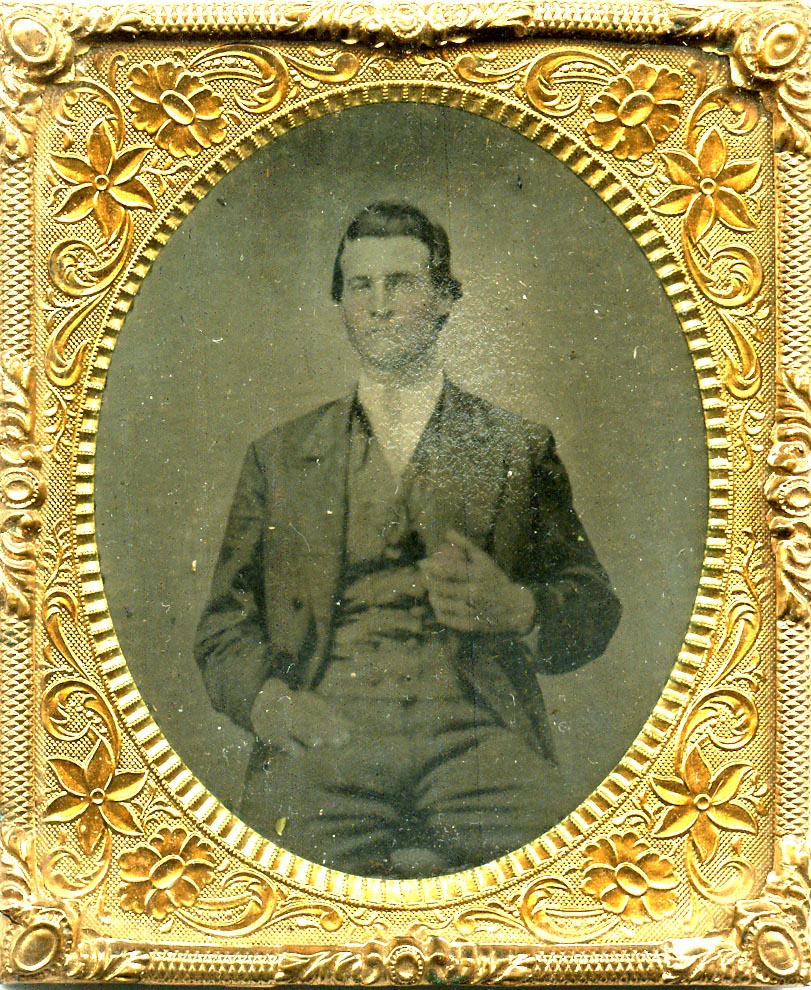
I had taken this photograph out of its case to scan it and discovered a mysterious stamp on the back.  It didn't look like a postage stamp, so I did an online search.
 
Pressed metal frame insert
The mysterious stamp
Penciled initials with "July"

The photo was taken between 1864 and 1866.  The subject appears to be in his mid-twenties, so I'm guessing he was born around 1840.  The photographer, whose initials were "BR," collected 2% of the cost of the photograph as a luxury tax. 


Revenue Stamps: 1864 Luxury Tax funds for the Union during the Civil War
By Act of Congress in August 1,1864 to August 1,1866, a tax was levied on the sale of luxury items to support the war for the Union. Sellers of "photographs, Ambrotype, daguerreotypes, carte de visite or any sun pictures" affix stamps to the backs of photographs at the time of sale, exempting photographs too small for the stamp. The denomination of the stamp was proportionate to the cost of the photograph, according to the following schedule (one cent stamps were used only when the appropriate denomination was unavailable):

Price of Photo          Tax 1864-1866          Stamp Color        
Less than.25                     .2                            Blue/Orange
.25 to .50                         .3                            Green
.50 to $1.                         .5                            Red
Greater than $1.               .5                            Red

The seller (photographer) would cancel the stamp by initializing and dating it. It was common to simply cancel with a quick stroke of the pen. Stamps properly canceled are valuable because the image can be precisely dated and the photographer accurately attributed.  Other kinds of stamps were used besides the regular Internal Revenue Stamp. Stamps specifically for photographs were never produced, it was left up to the photographer to use a stamp of the proper denomination.

http://www.photosmadeperfect.com/Photo%20Dating%20Page%20Top%20pg/AAPhotoDatingIntro%20Top%20Pg.htm

Sunday, January 9, 2011

Settie Graf Locke

Settie Graf Locke (1868-1955)

I often wondered how my great grandmother came to be called Settie.  She had an Aunt Sette, her father's  sister Sette ( Zetta) who remained in Germany.  I came across a Graf family tree which listed her as Zetta Graf, born to Philip.  In the 1880 census she is recorded as Elizabeth.  She is the 7th generation traced from the lineage of Nikel Grav.

NICKEL GRAV was born Oct 1655 in Imsweiler, Germany, and died 14 Nov 1735 in Insweiler, Germany. He married ANNA CHRISTINA MULLERS. She was born 1666, and died 03 Apr 1736 in Imsweiler, Germany.  Click here to see the lineage to present-day.

Settie went to DePauw University and graduated from the Normal School with a teaching certificate.  She entered in 1886 and was there through 1888, her "Third Term."   She became a school teacher and later was a truant officer for Howard County.  In my communications with DePauw I found out that Settie's older sister, Louisa, also attended DePauw!  She was listed as a Third Term student in 1889, so perhaps she had begun earlier and was reinstated in 1889.

DePauw began as Indiana Asbury University with just one professor and five students, with the first class graduating in 1840.  The college began admitting women in 1867, and by the 1910s slightly over half of the students were women.  Indiana Asbury became DePauw University in 1884-85.  The Ladies Hall, built that year, was a three-story dormitory with rooms for 80 women.  Women were required to live there.  Her professor, W. H. Mace, authored her history textbook, which ended with the Civil War!  She inscribed the inside cover Settie Graf, April 1888, Normal School DePauw University.


DePauw East College, 1890  (Photo credit: DePauw archives 2294EastCollege1890.tif)


Raw Deal

Sarah Locke was married to Eli, George Locke's brother.  She wrote this letter to the editor expressing her displeasure with the Hoover administration.  She remarks, "I lost my farm." 

I'd like to find the records for this and whether she was denied help in farm foreclosure.

My mother's comments:

The Sarah Locke who wrote the "Raw Deal" letter was Sarah Melissah Yager Locke, my Grandpa George's brother Eli's wife. We always called her Aunt Sally. Their children were Tom Locke, my father's best Rich Valley school friend, and Kate, my mother's best cousin. Uncle Eli died rather young, and Aunt Sally made her home with her daughter Kate and husband Albert Hostetler. We saw them often since they lived in the Touby-Smith-Yager community and we all attended the Rich Valley church.


The following is information about Hoover's administration (1929-1933) excerpted from www.whitehouse.gov:

Within months [of Hoover's election] the stock market crashed, and the Nation spiraled downward into depression. 

After the crash Hoover announced that while he would keep the Federal budget balanced, he would cut taxes and expand public works spending.

In 1931 repercussions from Europe deepened the crisis, even though the President presented to Congress a program asking for creation of the Reconstruction Finance Corporation to aid business, additional help for farmers facing mortgage foreclosures, banking reform, a loan to states for feeding the unemployed, expansion of public works, and drastic governmental economy.

Saturday, January 8, 2011

WANTED!

Hey family...help me out here!  I need some photos of ancestors, documents, family photos that 'tell a story', etc.


Can anyone identify these people?  They were in amongst other family artifacts.


Thursday, January 6, 2011

Emmett and Elsie (Locke) Touby

Emmett and Elsie (Locke) Touby
When Elsie Locke (1894-1975) and Emmett Peter Touby (1888-1972) were married in 1914 they settled on a farm in Howard Township, Howard County, owned by Emmett’s father, Albert C. Touby (1851-1931).  The marriage brought together the descendants of two pioneer families who had come to Howard County when Kokomo was just a trading post.
Elsie’s grandparents, Elias and Sarah Brown Locke, had traveled from Ohio to Howard County to stake their claim after the Miami Reserve was opened to settlement.  As their family grew, they built the large brick home, which still stands on North Locke Street in Kokomo.  The sixth of ten children, George Luther Locke (1856-1938), was Elsie’s father.  In 1891 George married the young schoolteacher, Settie Graf, and they began their life together in a log cabin on a farm in Liberty Township.  Their children, Philip R. and Elsie attended the one-room Martin school and later graduated from Greentown High School.  The families were respected citizens of the community.  George became known for his equitable handling as executor of family estates.

Emmett Touby’s grandparents, Peter and Jane C. Touby came to Howard County from Fayette County, Indiana in 1853.  Their children were Leora, Mary, and Albert C. Touby.  The Touby Pike that winds its way northeast of Kokomo followed a route that bordered the Peter Touby homestead.  Peter was instrumental in getting the road built (originally a “corduroy” road), and thus it was identified by his name.  In 1883 son Albert married Kate Willits (1858-1941), establishing their home on land north of the early homestead.  here they lived in a log cabin until they were able to build a large frame home where they raised their five children, Alice, Emmett P., Jennie, Mary, And Bessie.  Albert And Kate’s concern for the character of the community was evidenced by the fact that in 1896 they helped to establish and build the Rich Valley Christian Church just one-half mile east of their home.  Both the Locke and Touby families were influential in the early development of the county.

Upon the retirement of his parents and their move to Kokomo, Emmett and Elsie bought the home place and it was here that their five daughters, Louise, Dorothy, Frances, Virginia, and Joan were born and raised.  They attended the Howard Township School and the family was very active in the Rich Valley Church and the community. 

The Albert C. and Kate Touby home, later purchased by Emmett and Elsie.  Emmett is second from right.

Introduction and tribute

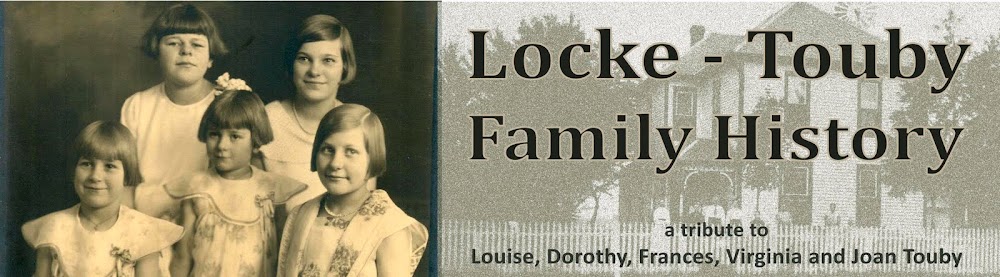
This project is dedicated to Louise, Dorothy, Frances, Virginia and Joan...the five Touby sisters.  Their grandparents were George and Settie LOCKE and Albert and Kate TOUBY.  My mother is Virginia, the fourth daughter born to Emmett and Elsie (Locke) Touby.  My mother (86) and my Aunt Dorothy (93) are the only surviving sisters. 

Gathering up and organizing a family history, and making it accessible and alive for this generation is a daunting task.  Hopefully by using this format my cousins and I can manage to pass on to our children and grandchildren a bit of the magic of what it was like to grow up in this family.

From left: Virginia, Frances, Joan, Louise and Dorothy