
Friday, April 1, 2016
GRAF Family History
This Graf Family history was published in 1921. Historians for the project were Emma Graf-Richer and Louise Graf-Froelich, sisters of my great-grandmother, Settie Graf-Locke. Click on the caption below the image to view the booklet.


Thursday, March 31, 2016
Emmett & Elsie as a young couple
Emmett Touby and Elsie Locke
Their homes were about seven miles apart, but the distance (rather significant in the late 19th-early 20th century rural setting) did not hamper Emmett's efforts to woo the sweet Elsie Locke. They had mutual friends... Elsie's cousins, Tom and Kate Locke, went to Rich Valley School with Emmett. It wasn't long before they got acquainted.
 |
| Rich Valley School on Road 500 N. |
 |
| Emmett comes calling on Elsie. In front of the Locke home. |
 | |||
| Elsie's brother, Ross, with Emmett (right). |
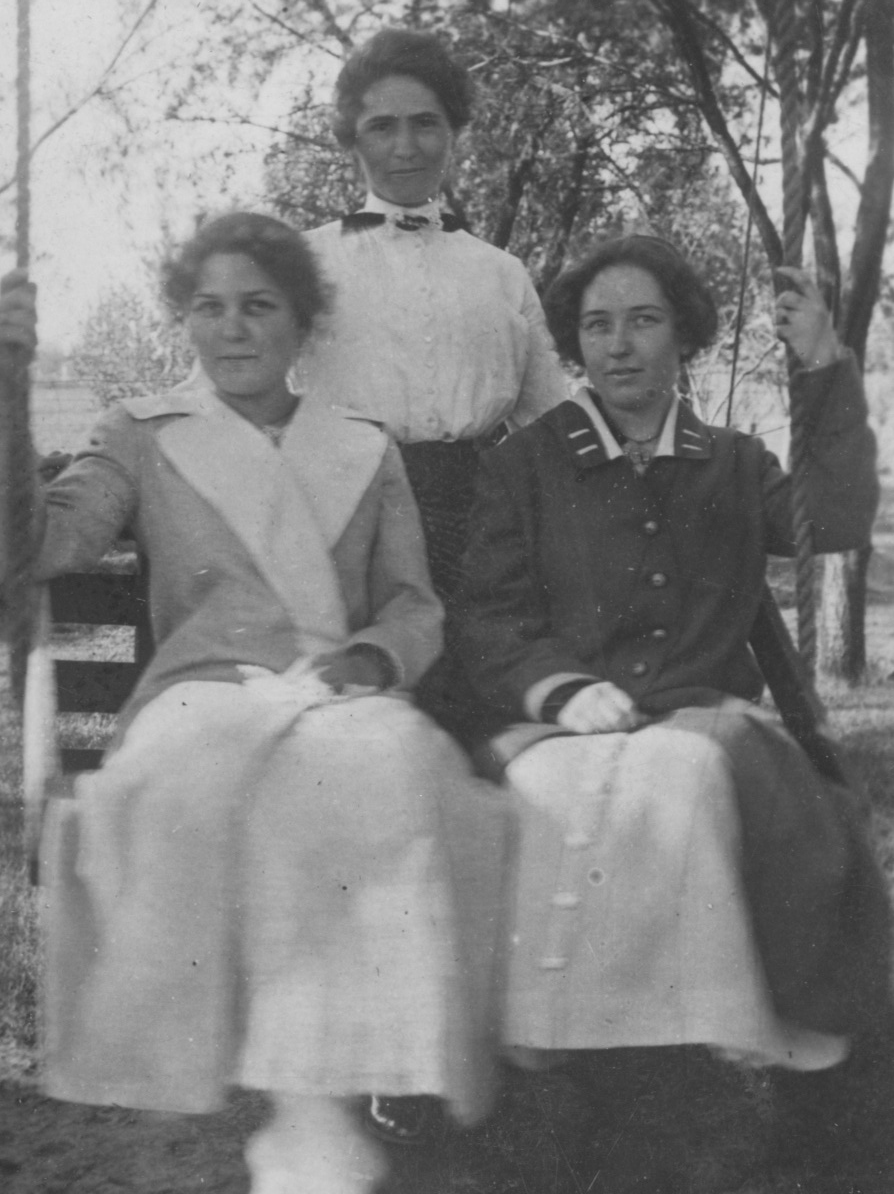 |
| Elsie and friends at Indiana State Normal School (now ISU) |
 |
| Elsie's college friends visit at the farm. |
 |
| Emmett (on left in carriage), Elsie on far right. |
 |
| Emmett and Elsie at the Locke farm. |
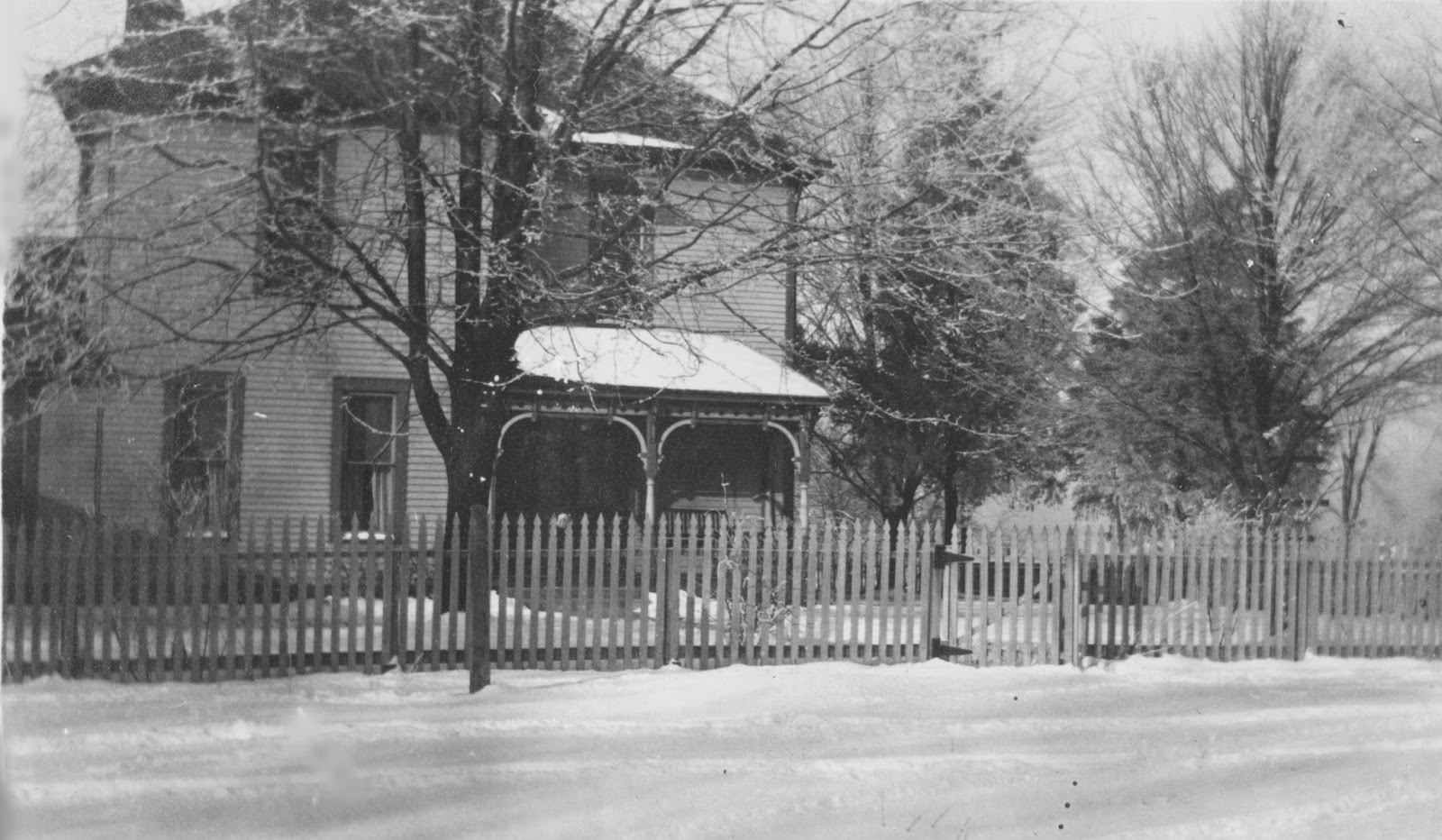 |
| The Touby home. |
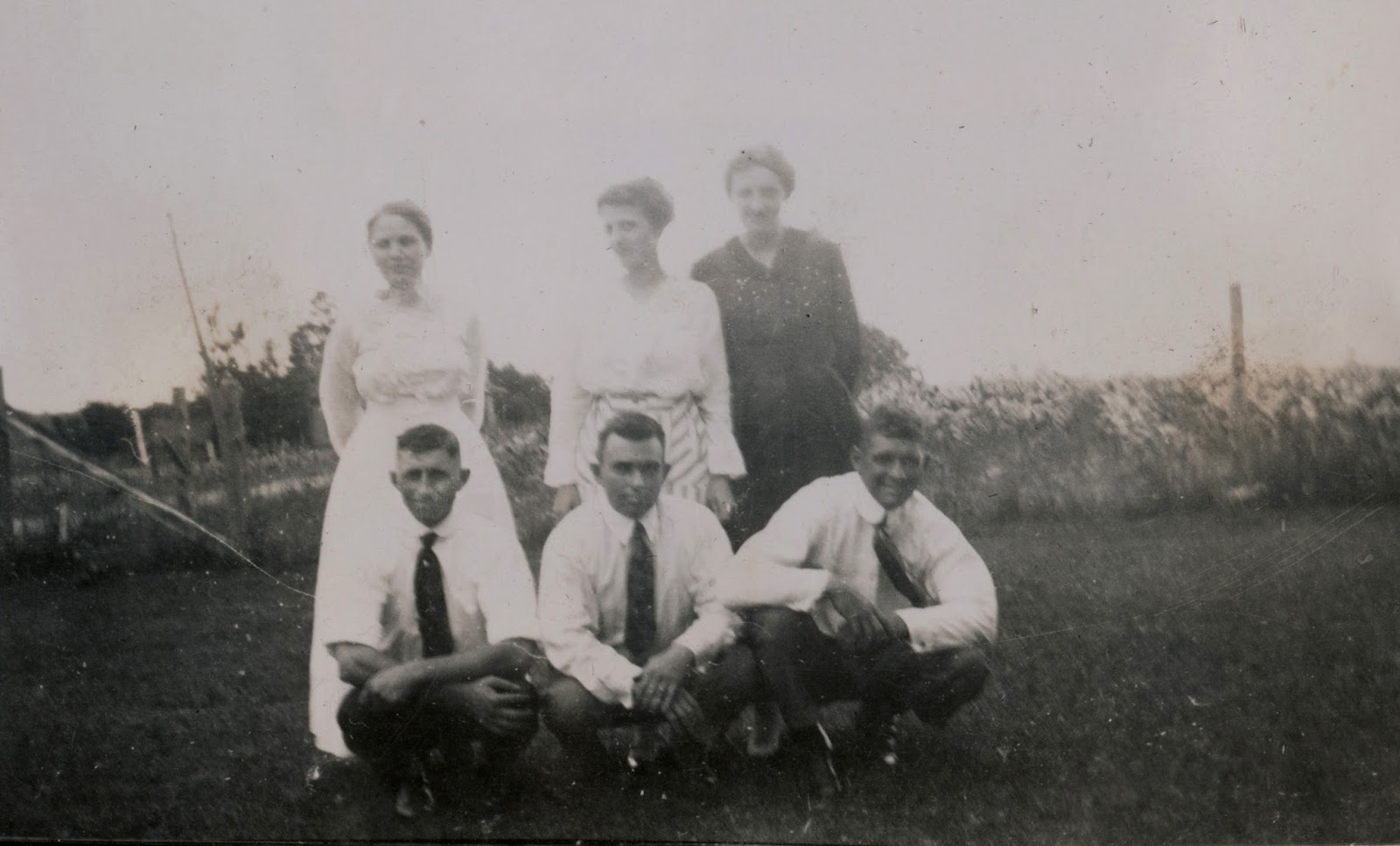 |
| Emmett and Elsie (on left) with friends. |
 | |
| Emmett and Elsie's wedding photo. |
Neighborhood News: June 29, 1903
This story was published in the Kokomo Daily Dispatch on June 29, 1903. It's interesting on so many levels... social norms, agricultural practices, gender expectations, language, politics, and history, to name a few. The story is transcribed exactly as it was written. For more stories on this blog about other homes in Howard Township (Howard Co., IN) click here
Peace and Plenty and the Spirit of Progress
Mark the Meanderings of Rural Route No. 7 --
Some Stories of the Yeager Neighborhood
Rural route No. 7 from the Kokomo postoffice is as full of crooks and abrupt turns as the life of a professional politician. It doesn't exactly cross itself anywhere, but the man would attempt to follow it without a guide or the friendly direction of the accommodating people along the route would find more difficulties than the department at Washington is bumping into just now in an effort at locating the looters who been doing things in official life which do not conform in any particular to either the spirit or letter of that commandment which forbids stealing, no odds if it be done on a gigantic scale.
But crooked as the route is, it meanders around through some excellent farm lands, picturesque scenery and by the homes of some of Howard county's most prosperous and up-to-date farmers. One would look a long time before a prettier stretch of farm lands and more comfortable homes and cosy surroundings would be found than are in evidence on every hand in the Yeager neighborhood. The homes are modern -- many of them are slate roofs -- and the lawns about them are neatly kept, and many of them as tastefully dotted with flowers and ornamental shrubbery as the best kept premises in the city, where some people imagine that culture and tidy-ness can only reach their broadest possibility.
Modern methods in farming are to be seen on every hand and every one seems to understand that work -- earnest, hard endeavor -- is the saving clause, and that God blessed the world with work rather than having cursed it when He informed our fore-parent that loafing in Eden was prohibited. Every one works and there appears to be no age limit. A few days ago one of the patriarchs of that locality, "Uncle" Jesse Yeager, accompanied by his cob pipe, was assisting in putting away clober hay, and at another farm a handsome young woman whose modest demeanor, hazel eyes and winsome ways are enough to give a young man a pain about the heart, was driving a horse that was drawing hay in great bunches into the mow, and there was no outward evidence that she was ashamed of her effort or considered labor humiliating.
On the Jesse Yeager farm there is a flowing well -- obtained while boring for gas -- that has been flowing constantly for the past ten years or more with a maximum pressure of about thirty pounds. In addition to supplying water on the Yeager farm it has been piped across the road and about one-eighth of a mile westward to the home of A. T. Hutson, furnishing water for stock. In the language of those who bore for gas or oil this well is a "duster." So far it has not been worked to its capacity or all its possibilities harnessed. It has been suggested that it might be made to drive a water moter that would run a dynamo large enough to furnish electric lights to several houses in the immediate vicinity. However, the practicability of this remains to be tried.
 |
| Jesse C. Yeager home |
On this route are many who, while very busy during the working season, do not neglect to keep pace with the times and are well posted on current events. Few men are better up with the times or have looked deeper into literature than S. S. Lovejoy. He is considered a thinker who can dig below the surface. Recently he has purchased forty acres of land joining his home farm on the west and has just finished inclosing it with a substantial wire fence. In building a home with comfortable surroundings he has an assistant in his wife* that insures success. It is said of her, that in addition to knowing all the details of domestic economy as practiced in a country home, she is a fine judge of stock, and could, if necessary direct the affairs of a farm successfully.
In the Yeager neighborhood, in addition to "Uncle" Jesse and his son, L. M. Yeager, there are John R. Trich, who has a pleasant home with outward surroundings giving evidence of a high order of rural life; Enos Wheeler, recently located there; A. J. Hutson, whose home is a model of neatness and convenience; H. H. Cole, who drives the business of an eighty-acre farm in a business way; W. T. Templin, a thoroughgoing farmer who has the reputation of being quite handy with all kinds of machinery. A long stretch of flower beds in the garden at Mr. Templin's home indicates that there is some one about the place who loves the beautiful -- those splashes of color and that delicate fragrance found only in flowers. While the writer did not make inquiry he suspects that Mrs. Templin is responsible for the pleasing variety of flowers about the place.
To mention all that is deserving on rural route 7 in one article would tax the reader. Some of the many things that might be mentioned are reserved for another notice of this route. Later route 2 will be due for mention in the Daily Dispatch, when we expect to refer to a number of others in the immediate neighborhood where routes 2 and 7 elbow for room at a cross roads in the Yeager neighborhood.
*This references Bessie (Touby) Lovejoy.
 |
| *Bessie (Touby) Lovejoy |
 |
| The winding road near the Touby home. |
Wednesday, March 23, 2016
The Journey: TOUBY
Our Touby family history is linked to the Remy and Strater families. Records show that on June 21, 1844, the Touby, Strater and Remy families left for America. Terrance Strater recently forwarded the passenger list for the Manchester which sailed from Antwerp on that very date. The list includes the families of Johann Peter Touby and Johann Martin Touby. The J. J. Hummerich family is also on that list, and I only recently became acquainted with Reinhard Hummerich (Germany) through this blog. He has traced our roots back to common ancestor, Heinrich Touby (1670-1759). More on that connection later.
Here are the Manchester ship records:


One year earlier, in July of 1843, the Brig Gulnare sailed from Antwerp with Captain John C. Tibbetts. the passenger list includes Hummerich, Remy, Strater (several spellings), and Corselius families - all names common to our Touby records. Terrance Strater sent this fascinating account of Captain Tibbetts' log (see link below).


Here are the Manchester ship records:


One year earlier, in July of 1843, the Brig Gulnare sailed from Antwerp with Captain John C. Tibbetts. the passenger list includes Hummerich, Remy, Strater (several spellings), and Corselius families - all names common to our Touby records. Terrance Strater sent this fascinating account of Captain Tibbetts' log (see link below).


Click here to read the ship journal written by Capt. John C. Tibbetts
His ship, the Brig Gulnare, sailed from Antwerp in July of 1843, arriving in New York on August 18, 1843, a 51 day voyage.
Sunday, January 31, 2016
Back home again in Indiana!
Touby Cousins Reunion #4
POTATO CREEK STATE PARK, INDIANA
In September 2015, we gathered back home again in Indiana. Phil and Karon hosted us the first night at their place where we were treated to a huge spread in Phil's "Garage Mahal." We toured the sights in South Bend, including the Studebaker Museum and Notre Dame. Back at the park, we had a nice campfire, made s'mores and sat under the stars.


Gene and Marcia drove from Oklahoma to join us in Greentown for a great visit with Mother! We toured Coan Engineering and the Touby Homestead.
Haynes Stellite 1942-43
The onset of World War II increased demand for Stellite alloys precision casting for aircraft engine components. Stellite was an extremely hard, heat-and-corrosion-resistant tooling metal developed and patented by Elwood Haynes. Beginning in 1941, Howard County mobilized for World War II. Kingston Products, Haynes Stellite and GM were some of the local businesses heavily involved in war production. Howard County Historical Society, "Footprints," February 2013, Volume 2, Issue 1.
Virginia attended Ball State for one year, 1941-42, but wanted to save up money for school and decided to work at Stellite the following year. The three shifts, which the workers alternated every couple of weeks, were 7 am - 3 pm; 3 pm - 11 pm; and 11 pm - 7 am. Her department produced wax moulds for aircraft superchargers, a top-secret war project.


Haynes Stellite was located in the SW part of Kokomo and Virginia took turns driving to the factory with her neighbor, Elsie Teel. Elsie's boyfriend at the time, Evert Donaldson, had been drafted and gave her his car to drive. Virginia drove the family car, a 1937 Chevy 2-door, when she worked the 2nd or 3rd shift. Jeanette Mohr (Lockhart) was her shift supervisor. Theresa Busby also worked at Stellite, but in a different department. Mom Oakley's, described as a local "greasy spoon," was a favorite place to hangout and dance for young women factory workers and the boys from nearby Bunker Hill Naval Base. They would flock there either after 2nd shift or before the third shift.

Virginia attended Ball State for one year, 1941-42, but wanted to save up money for school and decided to work at Stellite the following year. The three shifts, which the workers alternated every couple of weeks, were 7 am - 3 pm; 3 pm - 11 pm; and 11 pm - 7 am. Her department produced wax moulds for aircraft superchargers, a top-secret war project.

Photo credit: Indiana Historical Society, HAYNES_IMAGE_007

Photo credit: Popular Science, June 1941, "He Harnessed a Tornado"
Haynes Stellite was located in the SW part of Kokomo and Virginia took turns driving to the factory with her neighbor, Elsie Teel. Elsie's boyfriend at the time, Evert Donaldson, had been drafted and gave her his car to drive. Virginia drove the family car, a 1937 Chevy 2-door, when she worked the 2nd or 3rd shift. Jeanette Mohr (Lockhart) was her shift supervisor. Theresa Busby also worked at Stellite, but in a different department. Mom Oakley's, described as a local "greasy spoon," was a favorite place to hangout and dance for young women factory workers and the boys from nearby Bunker Hill Naval Base. They would flock there either after 2nd shift or before the third shift.

Photo credit: Indiana Historical Society, 1944, "Women making turbine blades for military planes," 1944_Stellite_S85P
The following excerpt is from "The History of Haynes International, Inc." by Charlie Sponaugle. Published in Metals Technology: Solidifying our Region's Wealth for a Third Century, Pittsburgh Engineer, Winter 2005, in an editorial comment by Ronald E. Ashburn, Executive Director for Iron and Steel Technology.
The History of Haynes International, Inc., excerpt
The History of Haynes International, Inc., excerpt
The company weathered the depression years selling its hard-facing alloys in industrial and agricultural applications and the new
Hastelloy alloys in the growing
chemical process industry. During
this time new melting technology
was moved to Kokomo from Union
Carbide’s facility in Niagara Falls,
NY. It was about 1940 that the first
wrought versions of the Hastelloy
alloys were being developed and
rolled at Ingersoll Steel and Disc
Company in New Castle, Indiana.
The 1940s were the beginning of a new era for the company. The second world war would alter the company’s future much as the first world war had done. One of the growing applications for Stellite was investment cast turbine blades (or buckets). These blades were used in the superchargers for military piston engines on a number of planes. Over 25 million buckets were produced for the war effort. Haynes Stellite alloys 21 and 31, both cobalt-based, were used in this application about 1941. Haynes Stellite was the premier investment casting house in the US at this time and supplied about 70% of the turbine buckets used.
Another application using both the Stellite alloys and the new Hastelloy alloys was search light reflectors for the US Navy. These metallic reflectors were shatter- proof and maintained a high luster even in saltwater environments. These reflectors were made from plate rolled by outside conversion sources using billet melted in Kokomo. Another factor in the growth of the company during the 1940s was the large amount of Hastelloy alloy used by the Manhattan Project and the Chemical Warfare Service.
Production during the war years was at an all time high, with employment reaching over 2,000 during the second world war and 3,000 by the end of the Korean war. A major milestone occurred in the late 1940s with the establishment of the wrought alloy plant in Kokomo. Prior to this, wrought products were finished by outside rolling mills. The new wrought alloy plant was situated on about 100 acres of land south of the main plant location. This new facility included rolling equipment for the production of plate and sheet products.
New high temperature wrought alloys were also being added. MULTIMET® (a nickel-cobalt- chromium-molybdenum-tungsten alloy) appeared in 1949 and in 1950 the cobalt alloy L-605 (now called Haynes alloy 25) was first manufactured. These alloys found increasing usage in aircraft superchargers and in the newly invented jet engine.
The 1940s were the beginning of a new era for the company. The second world war would alter the company’s future much as the first world war had done. One of the growing applications for Stellite was investment cast turbine blades (or buckets). These blades were used in the superchargers for military piston engines on a number of planes. Over 25 million buckets were produced for the war effort. Haynes Stellite alloys 21 and 31, both cobalt-based, were used in this application about 1941. Haynes Stellite was the premier investment casting house in the US at this time and supplied about 70% of the turbine buckets used.
Another application using both the Stellite alloys and the new Hastelloy alloys was search light reflectors for the US Navy. These metallic reflectors were shatter- proof and maintained a high luster even in saltwater environments. These reflectors were made from plate rolled by outside conversion sources using billet melted in Kokomo. Another factor in the growth of the company during the 1940s was the large amount of Hastelloy alloy used by the Manhattan Project and the Chemical Warfare Service.
Production during the war years was at an all time high, with employment reaching over 2,000 during the second world war and 3,000 by the end of the Korean war. A major milestone occurred in the late 1940s with the establishment of the wrought alloy plant in Kokomo. Prior to this, wrought products were finished by outside rolling mills. The new wrought alloy plant was situated on about 100 acres of land south of the main plant location. This new facility included rolling equipment for the production of plate and sheet products.
New high temperature wrought alloys were also being added. MULTIMET® (a nickel-cobalt- chromium-molybdenum-tungsten alloy) appeared in 1949 and in 1950 the cobalt alloy L-605 (now called Haynes alloy 25) was first manufactured. These alloys found increasing usage in aircraft superchargers and in the newly invented jet engine.
Friday, August 28, 2015
Graf - Locke Family History
My mother, Virginia Touby Coan, has been collecting bits of family history for years. During the past three years, she and I have worked on assembling this document that traces the history of the Philip Graf and Elias Locke families and their descendants who still reside in Liberty Township, Howard County, Indiana. Today is my mother's 92nd birthday and I honor her efforts by publishing this document on our family blog.

Happy Birthday, Mother!

Subscribe to:
Comments (Atom)